
Ergonomics
Patients often wonder if their desk car or bed are contributing to their pain. It’s definitely a possibility but it can be hard to work out what can be improved.
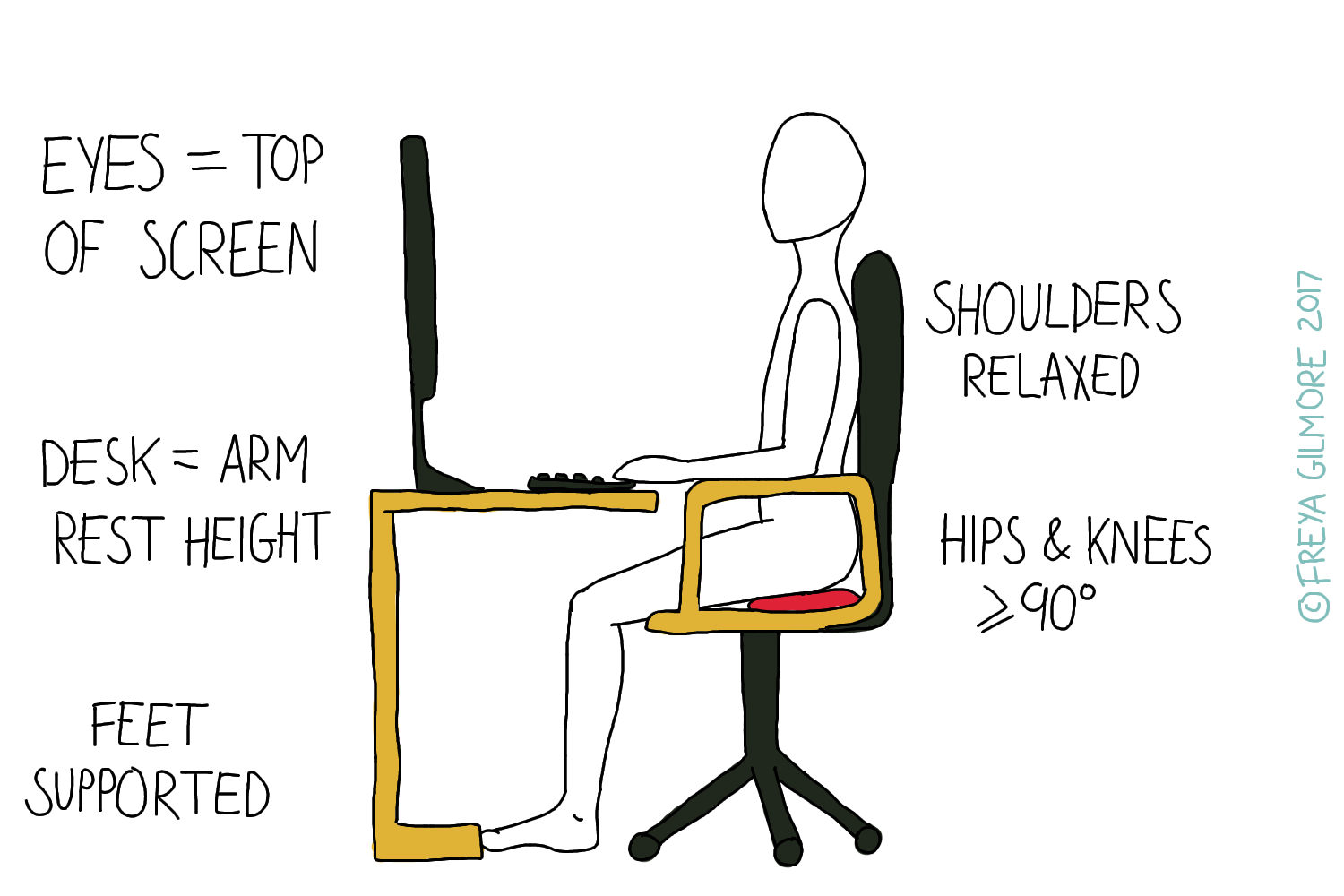
Rules of Ergonomics
As a general rule, whether we’re talking about your computer set up, your car, or how you sleep, you want to maintain as much of a neutral position as possible. Beyond that, you want to make sure that you’re moving through a range of positions throughout your time spent in that one place. It’s not very helpful to vilify any one position, as long as you’re not holding it for too long. Sitting on a bent leg at your desk for 20 minutes at a time is probably going to be more comfortable than holding the “perfect” posture all day!
Desk Ergonomic Guidelines
You’ve probably heard that your screen should be level with your eyes, but this is arguably not the most important marker. Generally changing the screen height fairly easy, but changing the table height might not be. Prioritise getting your seat high enough that your forearms are comfortably rested on your desk. Supporting your forearms discourages rounding the shoulders and developing upper cross syndrome. This might mean raising your seat quite a way higher than you expect, which, in turn, would mean finding a support for your feet. This support could be a simple as a box, it doesn’t have to be a proper footrest. From this starting position, your wrists should be relaxed, and not bent back to accommodate a keyboard or mouse. Try to avoid padded mouse mats too as they can put pressure on the front of the wrist and contribute to things like carpal tunnel syndrome.
Sitting and Standing
Standing desks are a bit different, but again if you aim to have your forearms comfortably rested on the desk while you’re standing that’s a good place to start. Bear in mind that your height (relative to the desk) is likely to change as you shift your weight about. Experiment with different screen heights until you find what works.
If you’re looking for a new chair, keep an open mind over what might constitute a good one. The best chair will fit you perfectly so it makes sense that a chair with lots of moving parts is likely to do a better job. Gaming chairs often fit this specification, although they can look quite daunting in their size and complexity. Your best bet is to try some out in person if possible.
Bed Ergonomics
If you tend to sleep in one position all night, it should be quite easy to set your pillows up for good ergonomics. As above, aim for neutral. If you sleep on your side, you’ll need more pillow height to keep your neck straight than if you sleep on your back. Front sleepers might actually do best without a pillow at all, although it’s very difficult to sleep on your front and maintain a neutral neck!
If you move around all night, it’ll be harder to get the pillows right but you might find that the movement keeps you relatively comfortable regardless. There are pillows designed for people who change position a lot, with a lower height in the middle of the pillow for back-sleeping, and more height at the edges for rolling onto your side. Personal preference is a big factor in pillow comfort, so it might be best to try folding up old pillows you already have before going out and buying a new one.
Osteopathy and Your Aches & Pains
Typically economics will only be part of the picture. Your osteopath can give you advice with your symptoms in mind to improve your economics but another key part of addressing your symptoms will be the hands-on treatment and exercises that we can prescribe. We can also identify which other symptoms might be associated with your posture, and what can be done to prevent their progression. Back pain and headaches are common issues that follow from dysfunction in other areas of the body, so it might not be coincidental that you feel like all of your symptoms have come on at once.
Click here to make an appointment for your aches and pains in Flitwick .