
Posture Basics: Kyphosis and Lordosis
If you look at your posture from the side, you’ll see that your spine will be made of three curves: two lordoses and one kyphosis. Kyphosis is where your spine arches backwards (as per your upper back) and lordosis is the opposite, as per your neck and lower back.
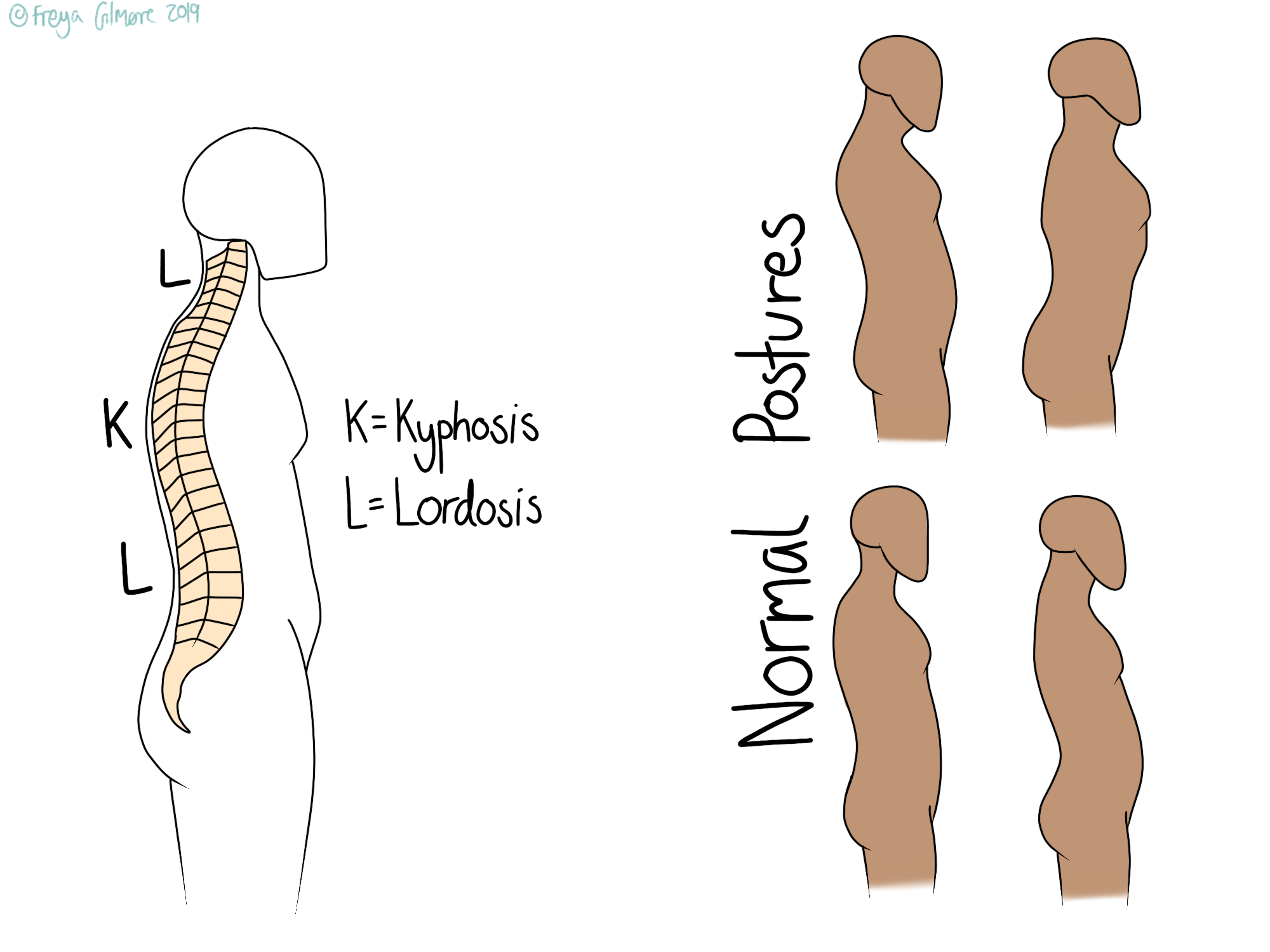
What is a Normal Posture?
Normal is broad. Some people will consider one specific posture to be the best one, but in reality we are all built differently, right down to a bony level. So what is the perfect posture for one person will not be perfect for someone else. Posture is only really an issue if it causes discomfort.
Although your osteopath will assess your posture as part of your overall examination, it may or may not be that significant to your picture. Note as well that your posture will change through your life. Babies are born with no lordoses, and as they become stronger and more mobile they develop. During pregnancy those spinal curves will change again. They may need an active attempt at rehabilitation to restore pre-pregnancy posture after birth. Through periods of injury and pain posture will change again to adapt. Often the hunching posture that can develop with old age is actually a response to hip arthritis.
It could be argued that the only bad posture is one that cannot adapt.
Scheuermann’s Disease
One condition of the spine sometimes just referred to as “kyphosis” is Scheuermann‘s disease. This develops in adolescence, causing a more dramatic kyphosis due to bony changes. As the child grows, the vertebrae take on a wedge shape, with the back of the vertebral body growing taller than the front. It affects boys more than girls, and can be diagnosed with imaging. We don’t know what causes it, but there’s likely a genetic component.
Physical therapy and back braces are the usual treatments of choice; the more appropriate one will be dictated by the severity of the kyphosis. Intervention needs to happen sooner rather than later, as once these bones ossify in late adolescence the shape will be permanent. For more severe cases we would expect patients to suffer with back and rib pain associated with prolonged sitting or standing. That said, it’s worth noting that the visual severity does not always correlate with the symptoms felt.
Maintaining Postural Mobility
With all of this in mind it makes sense that your aims should be to keep mobile rather than to aim for a specific posture. Exercises like yoga and Pilates can be particularly helpful for this. Or if you enjoy swimming, this is a great form of exercise to encourage mobility through the back without impact. If you do find that you have areas of tension or discomfort, your osteopath can help you identify exactly where they are and why they are happening. Sometimes a joint will get stuck and other joints will compensate for it. So if you find that you can get clicks out of your own back, but the pain persists, it may be because the one that really is stuck won’t be clicked by your stretches. Your osteopath can help to fill the gaps here.